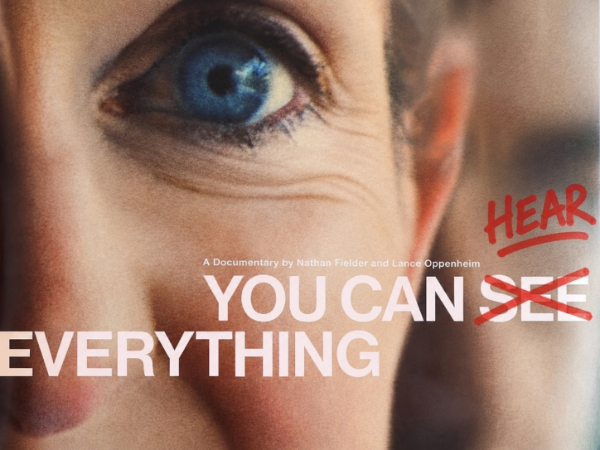
What tricks has the hit doc borrowed from podcasting? Let’s break it down.
The Long PauseOne of the first things you’ll notice about this movie, should you decide to watch it, are the looooong pauses. They happen almost every time Nathan Fielder asks a question.
To be perfectly honest, his questions are often not very good. But like I said, he’s a comedian, not a journalist.Nathan will ask his poorly worded and not very insightful question, and then he’ll wait. And wait. And wait. Until he gets an answer.
The thing is, this is a tried and true interview technique. It’s used in audio, in film and in journalism.
Like, this is Interviewing 101. Usually, those pauses are edited out. But in this case, even though the film is more than 3 hours long, the filmmakers left them in. They really lean into those pauses. You can get a spoiler-free sense of it, just from the
trailer.
I’m not sure that’s a choice I’ll ever make. But in a world where AI is willy-nilly editing the pauses out of many of our conversations, I found myself remembering all the things that can be conveyed by a long pause.
Meaning. Authenticity. Deception. Despair.
Pauses can be powerful. And uncomfortable.
But really, isn’t that the point?
Using ActorsPodcasters love a good reenactment. Always have, always will.
For many of us who started in public radio, our on-air debuts were providing the voiceover for translations.
Mine was memorable. I recorded it while I was a work-study student at WBUR. It was for a story about family planning in Latin America, and I’ll never forget my opening line: “I didn’t want the abortion, but I was 22 years old and had three children already….”
Over time, we got a bit more discerning and started paying actual actors to do our dramatic voiceovers. During my last few years at WBUR, I even partnered with a local community theater company to hold an open audition.
I especially love the voice actor who was chosen for
Dear Alana. It’s a podcast that came out back in 2023, but I didn’t listen to it until after I saw its creator, Simon Kent Fung, speak at Resonate last month.
There are lots of things I love about that podcast. But for me, the most consequential choice was the person they hired to read Alana Chen’s diary entries.
She’s emotive without being overwrought. Young without sounding childlike. And when we finally hear Alana Chen’s actual voice, it’s similar enough to the voice actor’s that we don’t feel like the rug has been pulled out from under us.
So, yeah, use a real actor. Not some poor work-study student you found wandering the halls!
Reacting to TapeSome of my favorite parts of the documentary are when Nathan Fielder and actress Amanda Seyfried talk through the script for her reenactments – and then the reenactments are shown as the actor and filmmaker react to the script.
Setting aside the deliciously meta device of showing an actor preparing for a role while she's simultaneously performing the role, this is something we do in narrative podcasting ALL THE TIME.
I’m gonna put a little plug in here for a project that journalist Sara Ganim and I have been working on for the past couple of years. It’s called
Mother Knows Best: Saving Jennifer and it is finally available on Audible.
(Yes, it’s behind a paywall. But you can listen to the bit I’m talking about for free.)
So, this is the story of a mother who was accused of Munchausen syndrome by proxy and the daughter she was convicted of abusing, who is now an adult.
One of the “markers” of a Munchausen mom is that she is supposed to be overemotional. Her love for her children is literally used against her in a court of law.
As a result, the mom in this case, Kathy Bush, was generally quite matter-of-fact when we asked her to tell her story.
The daughter, Jennifer Bush, is also matter-of-fact, but for a different reason. She’s lived through some horrific trauma and distancing herself from her emotions is a survival mechanism.
Getting either of these women to speak emotionally could be challenging. So, we pulled clips from news reports, home videos and psychologist appointments and had them react to what they were seeing and hearing in real time.
Then we mixed together the archive audio and the reactions so that they told one seamless story.
It’s an incredibly powerful technique, and you can hear how it sounds by clicking “preview”
on this page.
Telling the Process StoryWhen you think about the parts of
You Can See Everything that are making headlines, they’re often the parts that involve how the documentary was made.
Billy in the shower. Amanda’s surprise appearance. Nathan’s creepy stalker face.
Process isn’t something we see a lot in documentary film, but it’s something we really enjoy leaning into in the audio world.
Sara Ganim and I did this a lot in our previous project. It’s called Believable: The Coco Berthmann Story and we made it together back in 2023. (Come to think of it, that’s probably why I never listened to
Dear Alana. I was a bit busy that summer/fall!)
We faced a lot of challenges. A central subject who was not participating, victims who refused to go on the record, and a really dark and disturbing subject matter that had to be handled extremely carefully.
As a result, a lot of the heavy lifting was done with a process story. Sara and I actually started recording our conversations about what we were uncovering – and how we were uncovering it. And a lot of those conversations made their way into the podcast.
Acknowledging Bias and UncertaintyYou Can See Everything has taken a lot of criticism for this next bit, but I happen to think it’s the movie’s superpower.
The filmmakers bring the audience to a place where they might be inclined to feel empathy for Elizabeth Holmes and then acknowledge – in a shockingly concrete way – that they themselves might have been completely bamboozled. She might be running the same con on them that she ran on all those male investors and members of her board of directors.
A lot of people who hate this movie are pointing to this moment as if it were accidental. But I think the filmmakers knew exactly what they were doing.
One of my eternal frustrations with big budget documentaries – and this applies to film and podcasts – is that they often spoon-feed the audience one version of the narrative. There’s no nuance. No subtlety.
For a long time, I think funders assumed that’s what the audience wanted. People want a hero and a villain. And they want to know who’s who.
But life is not that simple. Stories are messy. Biases are real. And inevitable.
Those of us who do investigations run into this all the time. We can know the facts of a story. We can shuffle through all the evidence and try to make sense of it. But we can’t know what’s in someone’s heart. Not really. And we can’t know what really happened when no one was watching.
I’m reminded of Sarah Koenig and the original season of
Serial. We really hear her grappling with the ethics of all this. She genuinely likes Adnan Syed, a man who was just 17 years old when he was accused of murdering his ex-girlfriend. But she acknowledges that she can’t know for sure whether he’s innocent or guilty. And if he’s guilty, she’s undoubtedly doing harm by telling his story.
Which brings me back to my second visit to the theater to see
You Can See Everything.
The first time, I spent the whole movie trying to decide whether to believe Elizabeth Holmes. The second time, I stopped searching for a clear answer and just listened. To the pauses. To Nathan Fielder and Amanda Seyfried thinking out loud. And to the woman on my right who gasped and the guy to my left who scoffed.
I still don't know whether Elizabeth Holmes is for real. Neither do the filmmakers. But they had the nerve to build a film around the fact that we might never know what was in her heart.
So, is this our cue to tell more stories with unresolved endings?
Well, maybe not. With the funding landscape being what it is, the pressure to find a satisfying ending to your story isn’t going away anytime soon.
But a satisfying ending doesn't have to be wrapped up with a bow. There's still room to explore uncertainty. To let our stories get messy.
And to say the quiet part out loud.