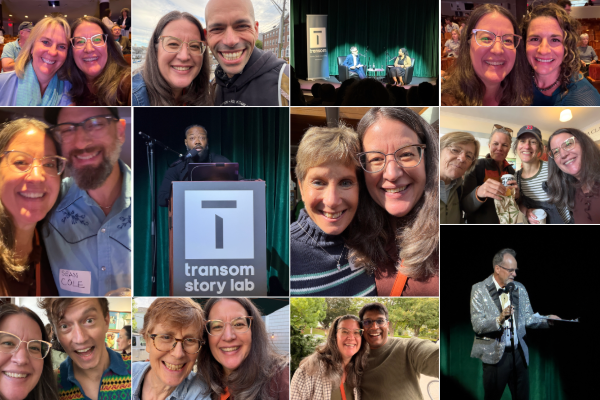
Without further ado, here are 5 lessons I took from Transom 25 that are helping me resolve my existential crisis.
Lesson #1: The industry is still bigger than it once was.Okay, I get it. I’m a dinosaur. I started in audio back when we were still cutting tape with grease pencils and razor blades.
Analog, baby!Back then, there was no money. I mean none.
Many of the radio reporters I knew had to relocate to rural Alaska for their first on-air jobs. I was lucky. I only had to move to Reno, Nevada for mine.
But somehow, we found jobs! We paid our bills. (Barely.) And, most importantly, we made beautiful, inspiring, important work.
Yes, the industry is smaller now than it was two years ago. But it’s still
bigger than it was 12 years ago, when season 1 of Serial was first released.
If there was room for good work before the bubble, then it stands to reason that there will be room for good work after the bubble.
It just might take a bit more elbow grease to get it done.
Lesson #2: It is still possible to scrap together funding.Maybe you’ve heard of the amazing Nichole Hill? Her podcast, Our Ancestors Were Messy, has won just about every award there is. It’s funny. And informative. And oh, so important for people to hear, especially right now.
But the big podcast funders have never really cared about words like “informative” and “important.” For a long time, the only words they wanted to hear were “true crime – but not too dark – with a strong potential to become a Netflix series.”
So Nichole had to bootstrap season 1 from her own savings. That’s not great. I feel strongly that people should get paid for the work that they do, especially if they work as hard as Nichole.
But she’s been able to keep going because she was able to build an audience, and then she asked that audience for help.
Season 2 is in production now. Sadly, I don’t know the details of how it’s being funded. She didn’t talk much about how the finances work during her talk at Transom 25. (Nichole! Call me! I’d love to know how you’re making it happen!!)
But just knowing that it IS still possible makes me happy.
Lesson #3: Sometimes, it’s not about the money.When I first decided to become a freelancer-by-choice, I was coming off a couple of decades in public radio. And the thing about a public radio career is that it makes you think of this work as a mission, instead of as a job.
That can feel really rewarding, in the moment. But when it ended, I was devastated.
And so I made a decision. I would do work that I loved. But I would do it for MONEY.
Sure, I give a lot of advice for free. I really enjoy talking with people and sharing what I know! But I don’t actually produce anything or edit anything or voice anything without there being a paycheck involved.But at Transom 25, I got to meet a lot of people who were doing both. They had work they did for pay…and work they did for love.
My friend, Sean Cole, did a whole talk about this. Sean was a staff producer at
This American Life for many years. He’s immensely talented and an absolutely lovely human. So when my friends and I heard that he had been laid off as part of the 2025 job cuts at TAL, we were SHOOK.
As you might imagine, Sean was shook, too.So Sean decided to do something that would feed his soul – in addition to the work he was doing to feed his electric bill.
He started making a weekly show called
The Writer’s Allman Brother. It’s a riff off of
The Writer’s Almanac. And let me tell you, you have to be a certain kind of NPR geek to get the inside joke here.
Confused? Lemme fill you in.The Writer’s Almanac was a daily 5-minute public radio program, hosted by Garrison Keillor, that aired on hundreds of stations nationwide.
Every episode started with the same solo piano music, followed by a list of birthdays and major historical events that happened that day, followed by Garrison reading a poem or two.
And every episode would end with the same sign off, “Be well, do good work, and keep in touch." If you’ve never heard it, you can find
old episodes here.
So, Sean being Sean, he thought he could do something with this. So he found a version of that piano solo, pitched his voice down to match Garrison’s deep baritone, and got to work.
Sean knows that this project will have a very limited appeal. Not everyone is going to get the joke...and that’s fine. He’s not doing it for everyone. He’s doing it for himself – and five of his friends.
That was actually the name of his talk, “How to Make Something for Five of Your Friends.”
I’m not going to spoil it for you. You just have to listen. I found
this recent episode to be especially giggle worthy.
Lesson #4: It’s not about the fame, either.To me, there was only one eye roll moment of the whole festival, and that was when Ira Glass complained that
This American Life used to get 5 million downloads per episode, but now the show only gets 3 million.
Seriously, Ira? I might have had more sympathy for you, if not for your inexplicable decision to lay off Sean Cole!To be fair, Ira does point to a very real issue. Many of us toil away on our projects, dreaming of the millions and millions of people who will hear them.
And trust me when I say this, no matter how many millions of people listen to your project, it’s not going to feel like enough.
I’ve produced projects that topped out at less than 100 downloads per episode and projects that have counted their downloads in the multiple millions.
In every single case, I’ve wished those numbers were higher.
So recently, I’ve stopped worrying so much about those total download numbers. For the most part, I’m not making podcasts that appeal to millions of people.
Instead, I’ve started asking my clients who they most want to reach.
It’s a powerful question.When the United Nations Foundation partnered with
Foreign Policy for a podcast about the challenges facing the next UN Secretary-General, of course they wanted to reach as many people as possible.
But when we drilled down to who they REALLY wanted to reach, it was the people who will be voting for the next secretary-general, and the people who advise those voters.
And voila! Our target audience had shrunk from 1.5 billion (the world’s English speaking population) to less than a thousand.
We’d also vastly changed how we approached the content for this podcast. Yes, we still wanted to make a podcast that was accessible to
Foreign Policy’s average listener. But we also needed to make sure that each episode had something new and relevant to say to people who work inside the United Nations every day.
Sometimes it’s not about how many people you reach. It’s about reaching the people who can make a difference.
Lesson #5: Stories will always have power.On the last day of the festival, Reveal’s Al Letson took us to church.
That’s really the only way to describe it. Al wasn’t trying to give us skills to use in our next edit. Or tips and tricks to keep a listener engaged.
He was inspiring us to have faith in the work that we do and the difference it can make.
I was too enraptured by the whole thing to take any notes. Thankfully, Transom Executive Director and festival guru Sophie Crane
published part of his talk in her recap of the event. Thanks, Sophie!
I can’t really say it any better than this, so I’m just gonna let Al take it from here.